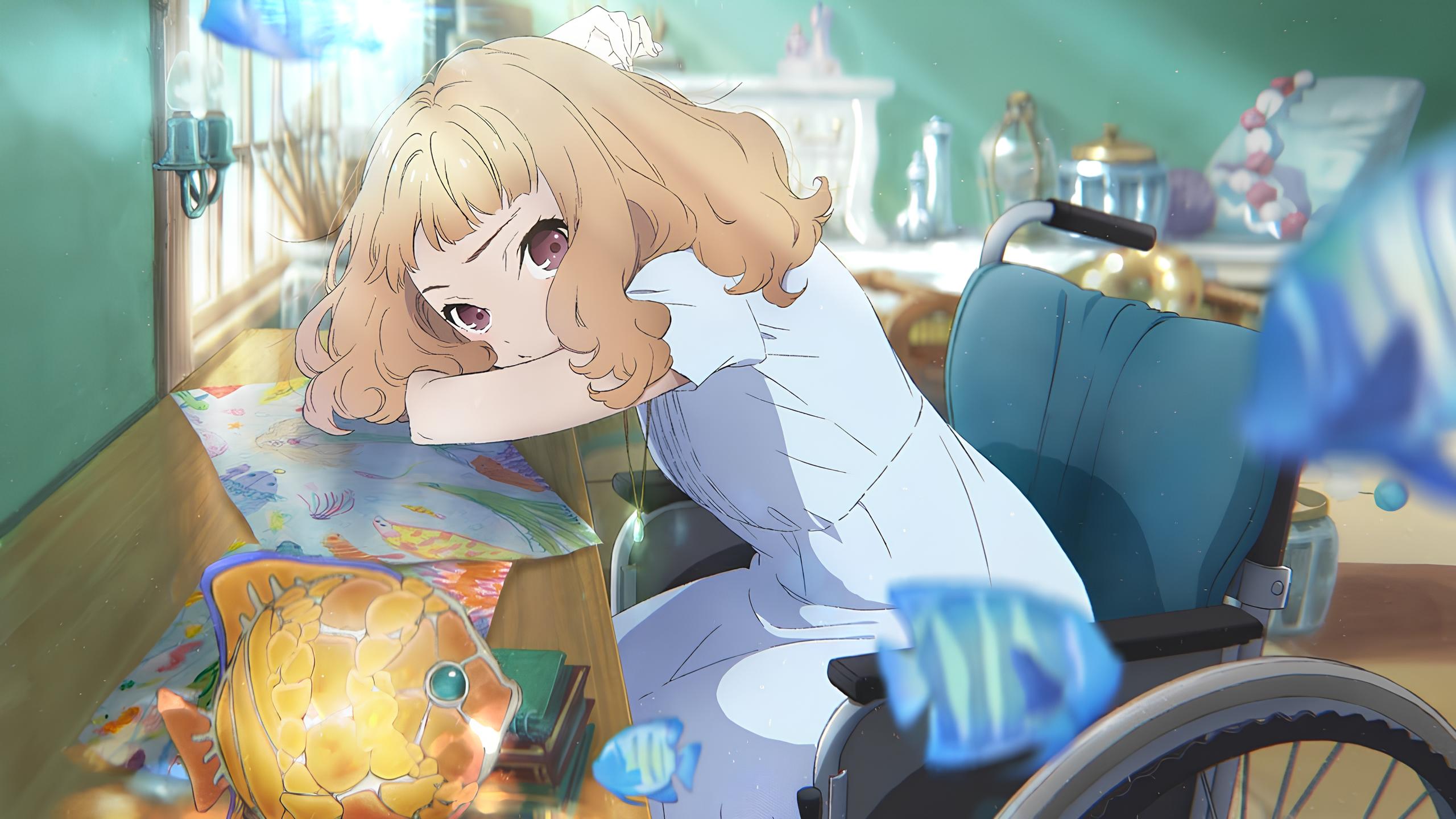
*Studio Bones' romantic drama works because its love story is ultimately about two people learning that caring for someone does not mean living their life for them.*
Some romance stories are built around the idea that finding the right person completes you. *Josee, the Tiger and the Fish* is more interesting than that.
Its central relationship matters precisely because Josee and Tsuneo are not there to complete one another. They meet while each is living inside a different kind of limitation, and their relationship gradually pushes both of them toward something larger: the difficult work of deciding what they actually want from life.
Directed by Kotaro Tamura and produced by Bones, the 98-minute 2020 animated film adapts a story by Seiko Tanabe, with a screenplay by Sayaka Kuwamura and music by Evan Call.
The result is a romance about affection, certainly, but also about dreams, dependency, fear and the difference between being protected and being free.
Two people with worlds still out of reach
Josee is an artist and wheelchair user who spends much of her life with her grandmother, surrounded by books, drawings and the private world she has constructed around herself. Tsuneo is a university student studying marine biology while working toward ambitions of his own. Their accidental meeting eventually puts them into each other's lives.
That premise could easily have become a familiar story about an energetic young man “showing the world” to a disabled woman.
The film is strongest when it resists that interpretation.
Tsuneo does introduce Josee to experiences beyond the boundaries she has grown accustomed to, but Josee is never interesting merely because he is present. She already has imagination, desires, talent and a personality that refuses to make things easy for anyone around her.
What changes is not that Tsuneo gives her a life.
He helps make it harder for her to accept a life defined entirely by fear.
And the distinction matters.
Independence does not mean being alone
One of the most affecting ideas in *Josee* is the tension between protection and independence.
Josee has understandable reasons to be cautious about the world outside her home. The people who care about her also have understandable reasons to worry. Yet protection can quietly become confinement when another person's fear begins deciding what someone is allowed to attempt.
The film does not present independence as the absence of help. Josee's wheelchair does not stop being part of her reality, and the support of others does not become inherently undesirable.
Instead, independence means retaining ownership over the direction of your own life.
That idea gives the romance weight. Tsuneo matters not because Josee becomes dependent on him, but because their relationship gradually changes what both characters believe is possible.
Love here is at its best when it becomes encouragement rather than possession.
Dreams are easy until they become vulnerable
Tsuneo initially appears to have the clearer path.
He studies, works and pursues a concrete goal connected to marine biology. Josee's ambitions are less publicly developed because much of her world has been kept private.
The film gradually places those two forms of dreaming beside each other.
Dreams can feel safe when they remain hypothetical. They become frightening once pursuing them creates the possibility of failure.
That is where *Josee* finds much of its emotional strength.
Both characters eventually have to confront the difference between wanting something and being willing to risk disappointment in order to pursue it. Romance does not eliminate that uncertainty. If anything, caring deeply for another person gives both of them more to lose.
The relationship therefore becomes less interesting as a question of **“Will they end up together?”** than as a question of **“Will they continue becoming the people they were beginning to imagine themselves as?”**
That is a much stronger foundation for a love story.
A romance built on mutual change
Josee and Tsuneo are not instantly compatible.
Their early relationship is confrontational, occasionally selfish and shaped by assumptions each makes about the other. But that friction gives the later emotional connection credibility.
The film allows affection to emerge through repeated exposure to another person's aspirations and vulnerabilities.
More importantly, the influence works in both directions.
Josee is not the only person who must learn something about independence. Tsuneo also reaches a point where determination alone is no longer enough to guarantee the future he imagined.
That symmetry prevents the relationship from becoming purely paternalistic.
Neither character exists simply to repair the other.
They both encounter moments in which the person beside them can offer support — but cannot make the necessary choice for them.
That is where the film's view of love becomes most convincing.
Bones gives imagination physical space
The production itself reinforces the film's central ideas.
Bones handled the animation, while Haruko Iizuka served as character designer and chief animation director, loundraw contributed concept design, and Evan Call composed the score.
Josee's imagination is especially important because the film repeatedly contrasts the world she can envision with the world she is learning to navigate.
That makes the medium of animation particularly appropriate for this version of the story. The Japan Media Arts Festival jury selection highlighted how the film's animated visual expression communicates Josee's imaginary world and the emotions shared between the two leads.
The beauty of the film is not merely decorative.
Its brighter, almost dreamlike visual moments make ambition feel tangible. The outside world can be frightening, but it can also be overwhelmingly beautiful.
That tension is central to Josee herself.
Where the film is less subtle
*Josee, the Tiger and the Fish* is unapologetically emotional.
For viewers who prefer romance grounded in restraint, some of its dramatic turns may feel carefully constructed to push the characters toward catharsis. The film knows when it wants the audience to feel afraid, hopeful or devastated, and it rarely hides those intentions.
That directness will not work equally well for everyone.
There is also only so much complexity a 98-minute film can give every relationship surrounding its central pair. Josee and Tsuneo receive the emotional architecture; several supporting characters necessarily function within a much narrower space.
But neither limitation undermines what the film is actually trying to accomplish.
It is not aiming for detached realism.
It wants emotional clarity.
And when its central themes converge, that sincerity becomes one of its greatest strengths.
Love is not the destination
The easiest way to describe *Josee, the Tiger and the Fish* would be as a romantic drama.
It is one.
But that description leaves out what makes it linger.
The film's most meaningful idea is that falling in love does not remove the need to become your own person.
Josee must learn that being afraid of the world does not mean she has to surrender her place in it. Tsuneo must confront what remains of a dream when circumstances make pursuing it harder than expected.
Their relationship gives both characters something valuable, but it does not replace those struggles.
That is why the romance works.
They do not save each other by providing an escape from life.
They help each other return to it.
For viewers who respond to emotional coming-of-age stories where romance, personal ambition and vulnerability are inseparable, *Josee, the Tiger and the Fish* is easy to recommend.
And beneath all of its beautiful skies, oceans and romantic imagery is a remarkably simple idea:
**loving someone can give them strength, but eventually they still have to move toward their own horizon.**
Join the discussion
What did you think? Share your perspective with other Anime Meridian readers.
The production embed will be loaded here after the site’s Disqus shortname and privacy/consent behavior are configured.