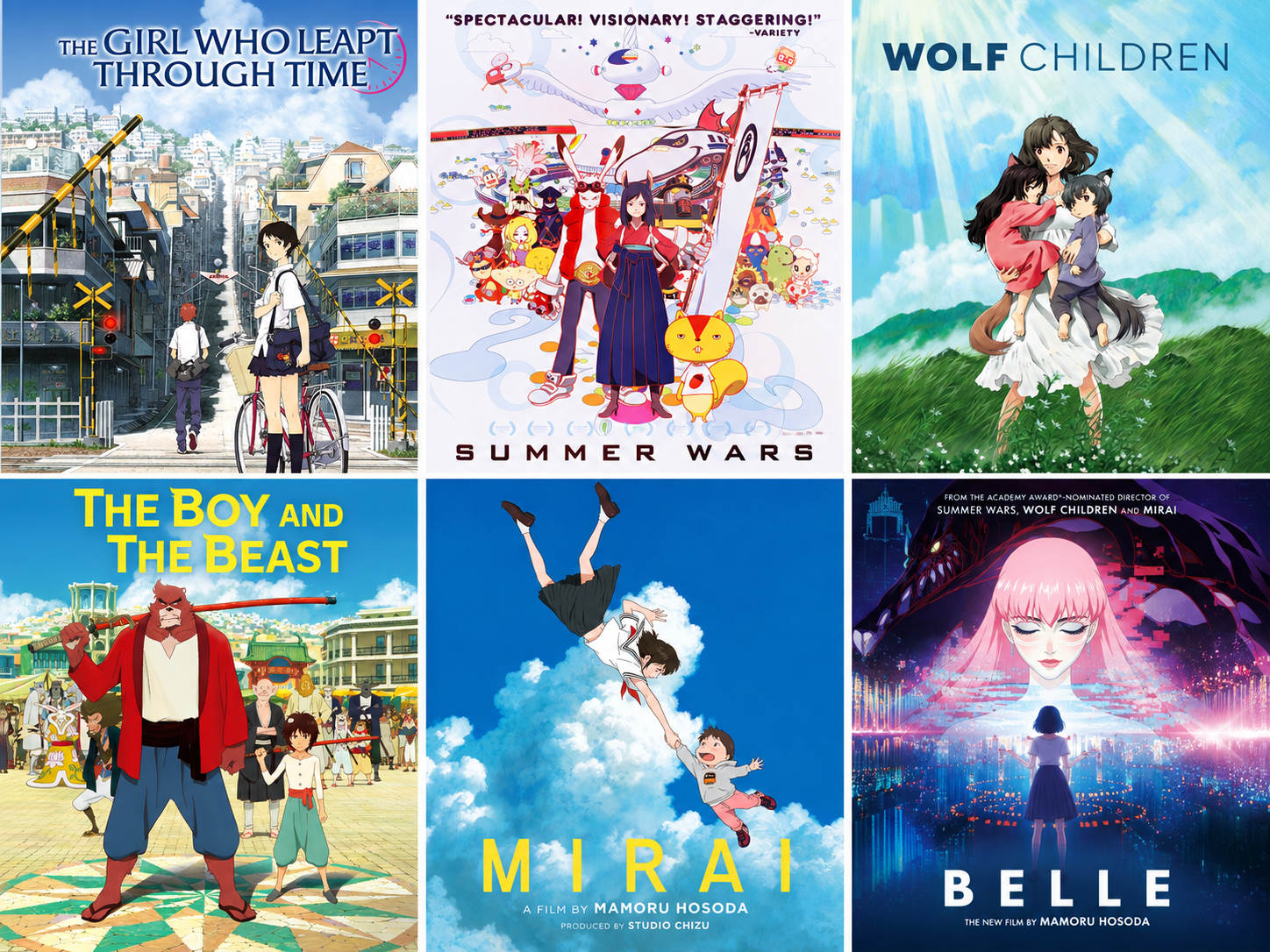
Mamoru Hosoda's movies are surprisingly easy to recognize once you have seen a few of them.
Families gather around crowded tables. Children struggle with the people they are becoming. Ordinary lives collide with impossible worlds. Technology can connect millions of people while leaving an individual desperately isolated. Parents have to accept that their children will eventually choose paths of their own.
But knowing Hosoda's reputation does not necessarily answer the simplest question:
**Which movie should you watch first?**
Studio Chizu currently lists seven feature films in Hosoda's modern filmography, from *The Girl Who Leapt Through Time* in 2006 through *Scarlet* in 2025.
There is no required order. These are standalone stories, so the best starting point depends almost entirely on what you want from an anime movie.
The short answer: start with Summer Wars
If you only want one recommendation, make it **Summer Wars**.
Released in 2009, the film follows Kenji, a high-school student drawn into both the sprawling Jinnouchi family and a crisis involving OZ, a virtual world deeply integrated into everyday life.
It is probably the most useful introduction to Hosoda because so many ideas associated with his later work already coexist inside it:
- family;
- digital identity;
- adolescence;
- technology;
- rural Japan;
- human connection;
- spectacular fantasy layered over ordinary life.
It is energetic enough to work as an adventure movie, emotional enough to demonstrate Hosoda's interest in family, and visually divided between two worlds — the warm physical space of the Jinnouchi household and the enormous digital environment of OZ.
If *Summer Wars* works for you, there is a good chance something else in Hosoda's filmography will too.
But it is not the only good place to begin.
Start with The Girl Who Leapt Through Time if you want romance and adolescence
**The Girl Who Leapt Through Time** is the easiest recommendation for someone who wants a smaller, more intimate story.
Makoto is a high-school student who unexpectedly discovers that she can leap backward through time. At first, she uses that ability to fix inconveniences and repeat moments she would rather change. The consequences gradually become much more personal.
Released in 2006, it was the film that helped establish Hosoda's reputation as a feature director. GKIDS describes it as part of the core catalog that also includes *Summer Wars*, *Wolf Children* and *The Boy and the Beast*.
Choose this one first if you like:
**coming-of-age stories, romance, school life and time travel.**
It is also a useful entry point because its scale is relatively modest. You meet Hosoda through characters and relationships before moving into the much larger worlds of *Summer Wars* or *Belle*.
Start with Wolf Children if you want the emotional one
If what you want is family drama, begin with **Wolf Children**.
Hana falls in love with a wolf man and eventually raises their two half-human, half-wolf children, Yuki and Ame. Much of the story follows the family as the children grow and begin deciding what kind of lives they want for themselves.
That description contains fantasy, but *Wolf Children* is fundamentally concerned with something very ordinary:
**raising children you cannot ultimately control.**
Parenthood, sacrifice, identity and letting go take precedence over spectacle.
It is perhaps the clearest example of another recurring Hosoda idea: family is important precisely because family members eventually become independent people.
Choose it first if you are looking for:
**family, motherhood, growing up and an emotional drama with light fantasy elements.**
And if this becomes your favorite Hosoda film, *Mirai* should probably be next.
Start with The Boy and the Beast if you want adventure
**The Boy and the Beast** is the easiest entry for someone approaching Hosoda primarily as an action/fantasy director.
A boy living alone on the streets of Shibuya encounters Kumatetsu, a warrior from the Beast Kingdom who takes him on as an apprentice. Their relationship develops through training, arguments and the unusual family they gradually create around themselves.
There is more conventional action here than in several other Hosoda films, but the emotional core is still recognizable.
The master-apprentice relationship becomes another variation on parent and child.
Start here if you want:
**fantasy worlds, fights, mentorship and found family.**
It is also a good bridge between action-oriented anime and Hosoda's more domestic films.
Start with Mirai if family itself is the adventure
**Mirai** might be the most unusual starting point.
Its protagonist is not a teenager but four-year-old Kun, whose comfortable world is disrupted when his baby sister Mirai arrives. Through encounters with family members across different points in time, the film turns one child's jealousy into an exploration of generations and family history.
The film received an Academy Award nomination for Best Animated Feature, making Hosoda the first Japanese director outside Studio Ghibli to receive a nomination in that category.
But awards do not necessarily make it the easiest introduction.
*Mirai* deliberately adopts a small child's perspective. Everyday frustrations become enormous events. Fantasy appears almost casually within domestic life.
Start here if you like:
**family stories, childhood, magical realism and quieter films.**
If you need a strong conventional plot to pull you through a movie, I would save *Mirai* until later.
Start with Belle if you want Hosoda in the age of social media
If *Summer Wars* imagined how a vast digital network could become embedded in society, **Belle** revisits virtual identity from the perspective of social media, performance and self-expression.
Suzu is a shy student living in rural Japan who becomes Belle, a globally famous singer inside the massive virtual world known as U. Her online identity gives her a way to express something she struggles to access offline.
Released in 2021, *Belle* combines spectacle, music, internet culture and a loose engagement with the structure of *Beauty and the Beast*.
Choose it first if you want:
**music, spectacular animation, virtual worlds and stories about online identity.**
If you enjoy its contrast between the digital and physical worlds, watch *Summer Wars* next.
The pairing is particularly interesting because it shows Hosoda returning to related questions about technology more than a decade apart.
And what about Scarlet?
Hosoda's newest feature, **Scarlet**, was released in 2025 and has continued its international rollout through 2026. Studio Chizu describes it as a time-bending adventure about a medieval princess pursuing revenge for her father's death before encountering a young man from the present day.
It introduces sword fighting, revenge and a more overtly historical-fantasy framework into Hosoda's feature catalog.
You certainly *can* start there — every film discussed here is standalone.
But for someone specifically trying to understand **Mamoru Hosoda as a filmmaker**, I would still begin with one of the earlier films that established the themes most strongly associated with his work.
*Scarlet* becomes more interesting once you have something to compare it with.
Choose your first Mamoru Hosoda movie
For the best all-around introduction, start with **Summer Wars**. Choose **The Girl Who Leapt Through Time** for romance and time travel, **Wolf Children** for emotional family drama, **The Boy and the Beast** for action and fantasy, **Mirai** for childhood and family, **Belle** for music and virtual worlds, and **Scarlet** for fantasy and revenge.
All of Hosoda’s feature films are standalone stories, so the best place to begin is simply the one that matches what you already enjoy watching.
A good Mamoru Hosoda watch order
If you enjoy your first film and decide to explore the director more systematically, then chronological order becomes much more interesting:
- **The Girl Who Leapt Through Time** — 2006
- **Summer Wars** — 2009
- **Wolf Children** — 2012
- **The Boy and the Beast** — 2015
- **Mirai** — 2018
- **Belle** — 2021
- **Scarlet** — 2025
This is also the sequence presented by Studio Chizu's feature-film catalog.
Watching them this way makes some recurring concerns particularly easy to notice: adolescence gradually gives way to parenthood; families become increasingly central; and Hosoda repeatedly returns to the relationship between the worlds people inhabit and the identities they construct inside them.
The technology changes.
The families change.
The age of the protagonist changes.
But the question beneath many of these films remains remarkably similar:
**How do we become ourselves while remaining connected to other people?**
That is probably the best reason to keep watching after your first Mamoru Hosoda movie.
Official movie pages
- [The Girl Who Leapt Through Time — Studio Chizu](https://studiochizu.com/works/the-girl-who-leapt-through-time?utm_source=chatgpt.com)
- [Summer Wars — GKIDS](https://gkids.com/films/summer-wars/?utm_source=chatgpt.com)
- [Wolf Children — GKIDS](https://gkids.com/films/wolf-children/?utm_source=chatgpt.com)
- [Mamoru Hosoda Collection — GKIDS](https://gkids.com/hosoda/?utm_source=chatgpt.com)
- [Mirai — GKIDS](https://gkids.com/films/mirai/?utm_source=chatgpt.com)
- [Belle — GKIDS](https://gkids.com/films/belle/?utm_source=chatgpt.com)
- [Scarlet — Studio Chizu](https://studiochizu.com/works/scarlet?utm_source=chatgpt.com)
Join the discussion
What did you think? Share your perspective with other Anime Meridian readers.
The production embed will be loaded here after the site’s Disqus shortname and privacy/consent behavior are configured.