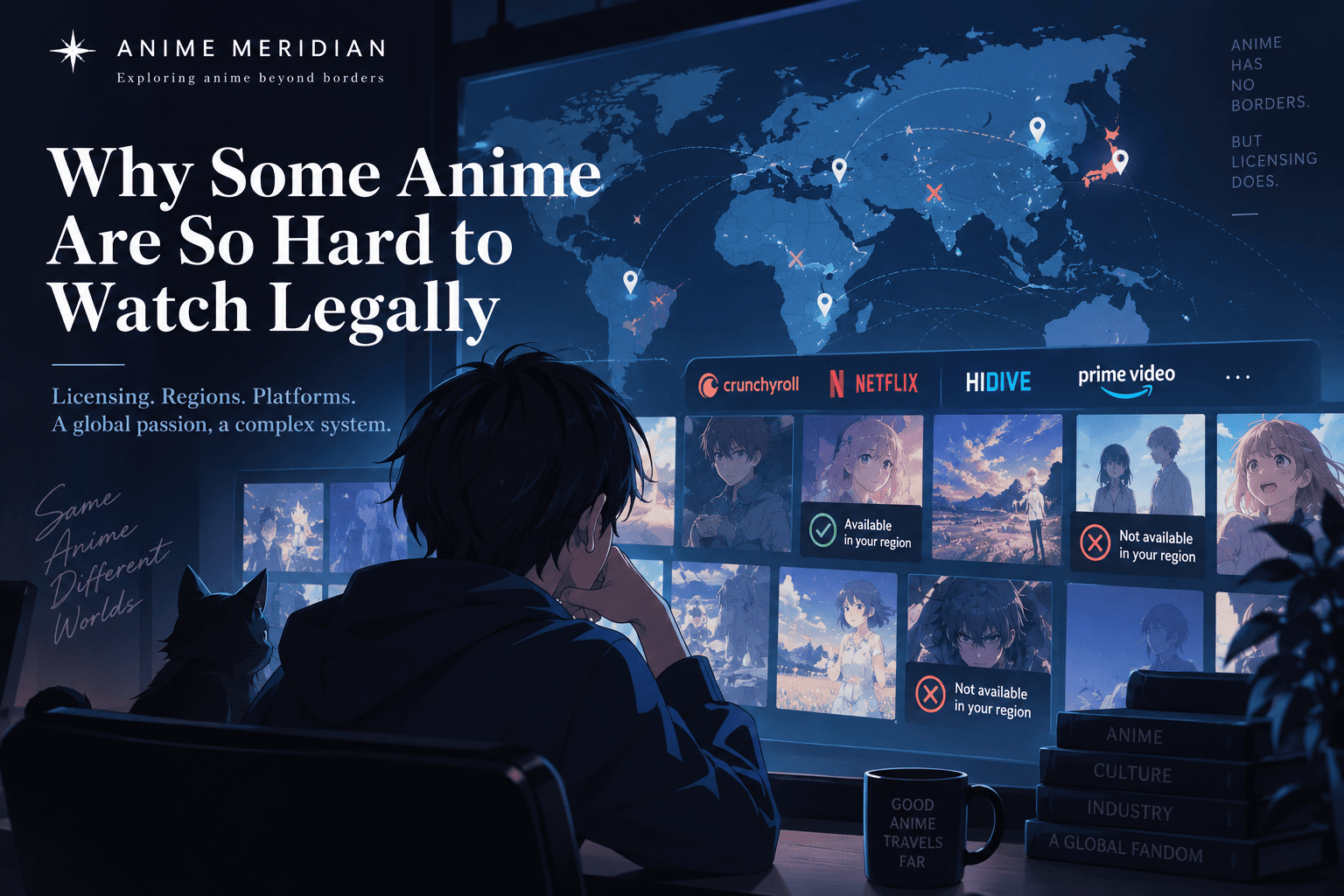
Finding an anime online sounds as though it should be simple.
You know the title. You have subscriptions to major streaming services. The show has been officially released outside Japan. Maybe you have even seen people in another country discussing the exact platform where they watched it.
And yet, when you search for it, it is nowhere to be found.
That does not necessarily mean you searched badly. In some cases, there genuinely may be no licensed streaming option for that anime in your region.
The reason is that legal anime distribution is not one global switch that can be turned on for everyone. It is a network of contracts.
And those contracts have borders.
Streaming rights are not the same thing as owning an anime
When a platform licenses an anime, it does not necessarily receive unlimited permission to show that title anywhere, forever.
Crunchyroll's own explanation of the localization process describes [licensing as an agreement](https://www.crunchyroll.com/news/deep-dives/2023/3/25/feature-how-anime-gets-localized) between a Japanese rights holder — sometimes a company or production committee — and a distributor. Those agreements can have expiration dates and can cover different uses of the property.
That distinction is the foundation of the problem.
A company can have permission to stream a title without owning the underlying anime. Its contract determines what it is actually allowed to do.
In audiovisual licensing more broadly, agreements can restrict rights by **[territory, duration and means of exploitation](https://www.wipo.int/wipolex/en/text/434415)**.
So “Crunchyroll has this anime” or “Netflix has this movie” is often an incomplete sentence.
The more useful question is:
**Where, for how long, and under what rights?**
The same anime can have different homes in different countries
Geography is one of the most visible consequences of that system.
Crunchyroll explicitly says that some titles cannot be watched in every country because[ streaming licenses differ by territory](https://help.crunchyroll.com/hc/en-us/articles/43269213267092-Why-can-t-I-watch-certain-shows-in-my-region). Each title is licensed for particular regions according to the agreements attached to it.
Netflix describes the same basic problem from its side. A title may have [multiple rights holders](https://help.netflix.com/en/node/125345), Netflix may obtain rights in one region before another, or another streaming platform may already hold exclusive rights somewhere else.
This means two subscribers paying for the same streaming service can legitimately see different anime libraries.
A license could cover the United States and Canada but not Latin America. Another could cover Latin America while excluding parts of Europe. Some agreements cover much of the world but specifically exclude Japan or another Asian market.
There is no contradiction there.
They are different contracts.
This is also why Anime Meridian treats streaming availability as **regional information**, rather than writing simply “Streaming on Crunchyroll” as though that statement automatically applied worldwide. Our sourcing rules specifically require platform and territory to be verified separately.
One title can contain several different rights
Even geography does not tell the whole story.
“Rights to an anime” can describe several different forms of distribution.
Streaming is one. Television broadcast can be another. Theatrical exhibition, physical Blu-ray releases and digital sales can also operate under different arrangements.
Netflix offers a particularly easy example of how granular this can become: its support documentation notes that the company can have the rights [to **stream** a title without having the rights to make that same title available for **download**](https://help.netflix.com/pt/node/54870).
VIZ Media similarly describes anime distribution rights across [broadcast and streaming, home video, and electronic sell-through](https://cpg.viz.com/) as distinct areas of its licensing business.
So seeing an anime receive an official Blu-ray release in a country does not automatically mean somebody holds streaming rights there.
A theatrical release does not automatically promise a subscription-streaming release immediately afterward.
And a platform that streamed one season of a series does not automatically possess every future season.
For viewers, all of those versions may look like the same anime.
Contractually, they do not have to be the same product.
Licenses also expire
Then there is time.
[Crunchyroll's licensing explainer notes that licensing agreements generally have an expiration date](https://www.crunchyroll.com/news/deep-dives/2023/3/25/feature-how-anime-gets-localized). Once the relevant rights expire, the distributor can no longer continue using the property under that agreement.
Netflix likewise says licensed titles can be [available only in specific countries **or for a limited period**](https://help.netflix.com/en/node/4976). When a license approaches expiration, Netflix says factors such as whether the rights remain available, regional popularity and licensing cost influence whether the title stays in the catalog.
This helps explain one of the stranger experiences of legal streaming:
An anime can be perfectly easy to watch for years — and then disappear.
The show itself has not vanished. The copyright has not necessarily changed. What may have ended is the platform's permission to distribute it.
If another company does not acquire those rights, or the existing license is not renewed, a legal streaming gap can emerge.
This can be particularly noticeable with catalog titles that are no longer being actively promoted. Being famous enough to have received an international release once does not guarantee permanent streaming availability.
A streaming library is not an archive.
It is a collection of active agreements.
“Available” may still depend on language
Even when the anime itself is legally available, the version you want may not be.
Subtitles and dubbing introduce another layer.
Netflix says that [audio and subtitle options can depend on location](https://help.netflix.com/pt/node/101798), the individual title and licensing agreements.
Crunchyroll similarly notes that [dubbed content availability can vary according to region](https://help.crunchyroll.com/hc/en-us/articles/22743917983892-How-can-I-find-dubbed-content-only).
That creates situations that can initially look bizarre.
A series might be available legally in a country with Japanese audio and one subtitle language but not another. A dub may exist elsewhere but not be licensed for your market. Another territory may receive a different set of localization options.
So the question is sometimes not merely:
**“Is this anime available?”**
It is:
**“Is the version of this anime that I can actually understand available?”**
For an international audience, that difference matters.
The streaming service itself may not be available everywhere
There is another complication that has nothing to do with the individual anime.
The platform holding the rights might not operate in your country.
HIDIVE, for example, [withdrew its service from certain territories](https://support.hidive.com/kb/guide/en/why-is-hidive-no-longer-available-in-my-country-CQgwHUoFir/Steps/4307613) outside North America beginning in late 2023. Its current help documentation also explains that the catalog shown to a user is determined by the [streaming rights HIDIVE holds for that user's location](https://support.hidive.com/kb/guide/en/how-do-i-know-what-content-is-available-in-my-country-SyEubXSTwR/Steps/4307600).
This creates another possible gap.
A distributor can license an anime internationally, but if its consumer service does not operate where you live — and no local sublicense or alternative distributor exists — the practical result for the viewer may still be no accessible legal stream.
The rights exist.
The anime has an international distributor.
And you still cannot watch it.
Why older anime can fall through the cracks
The internet has created an understandable expectation that media should become easier to access as it gets older.
Licensing does not always work that way.
An older anime may have gone through television distribution, physical media releases and one or more streaming agreements over many years. Those agreements can expire, companies can leave markets and platforms can decide not to renew titles when the economics no longer justify the license.
That produces an odd distinction between **existence** and **availability**.
A title may be well known. DVDs may have been released. Reviews and trailers may still be everywhere online. The anime may even remain legally available in another country.
None of that proves that a current streaming license exists in yours.
For viewers discovering anime years after its original release, the legal catalog can therefore feel less like a complete library of the medium and more like a constantly changing snapshot of which agreements happen to be active today.
What viewers can actually do
There is no single database that can make every licensing problem disappear, but a few habits make legal availability easier to understand.
Check the title directly on the major services operating in your country rather than assuming a search result from another region applies to you. Look at the anime's official website or distributor announcements when a new release is involved. Pay attention to territory wording such as “North America,” “selected regions” or “worldwide excluding” — those phrases are not interchangeable.
And when a legal option cannot be found, the answer may simply be that **no current streaming license covers your region**.
That is frustrating, but it is more accurate than assuming every anime that exists somewhere online must have an official stream everywhere.
A global medium still has regional borders
Anime has become increasingly international. Sony reported in 2026 that [Crunchyroll alone had passed 21 million paid subscribers globally](https://www.sony.com/en/SonyInfo/News/Press/202605/26-012E/), while describing anime as a business spanning production, fan engagement, marketing and worldwide distribution.
But global audiences do not automatically create global rights.
The technology can deliver the same episode almost anywhere in seconds. The contracts deciding whether that delivery is permitted are still divided by countries, platforms, languages, formats and time.
That is the paradox behind some of anime's most frustrating availability problems.
The work may already have crossed the ocean.
**The license may not have crossed with it.**
Join the discussion
What did you think? Share your perspective with other Anime Meridian readers.
The production embed will be loaded here after the site’s Disqus shortname and privacy/consent behavior are configured.